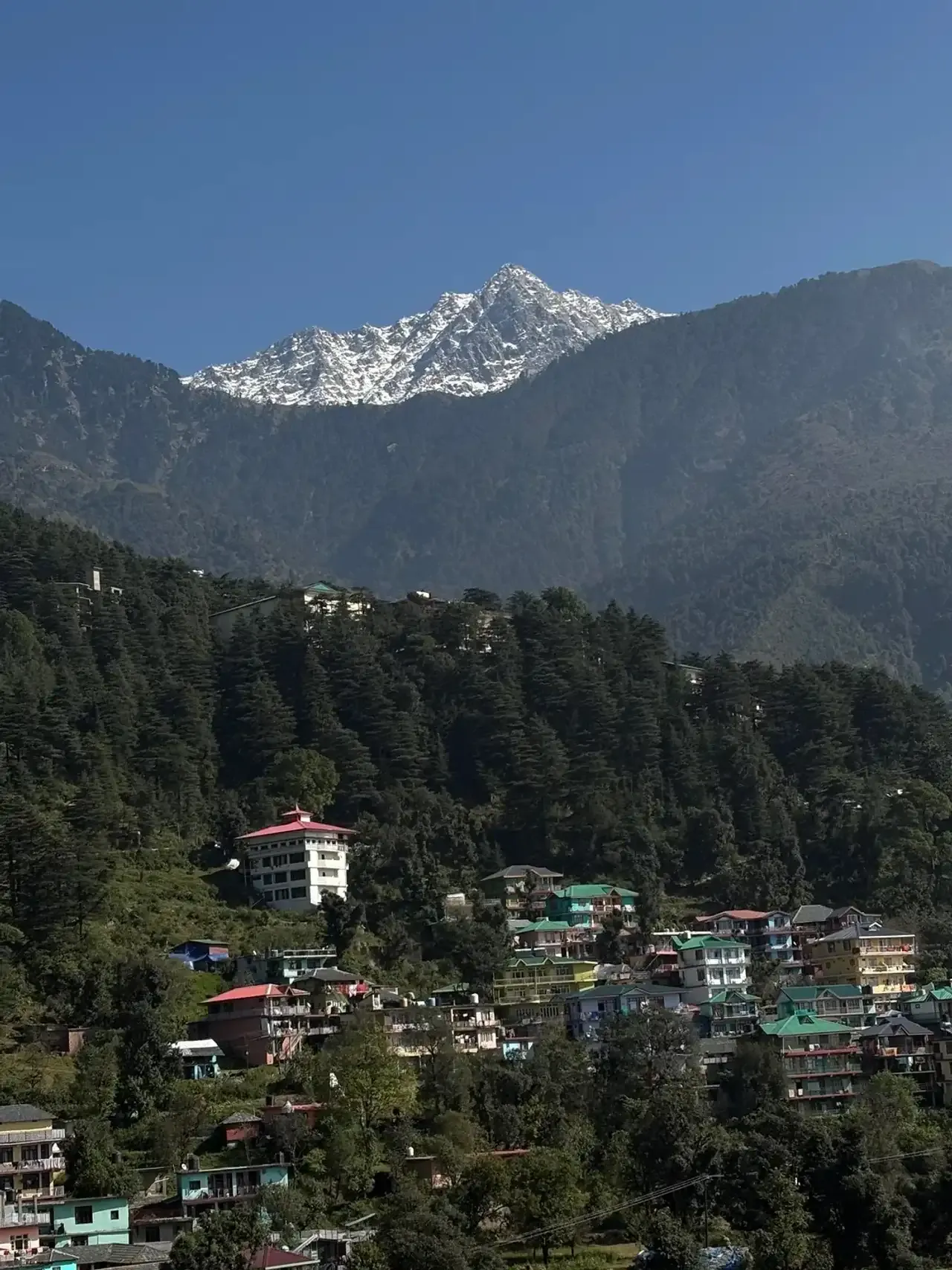
The Kangra Fort is the kind of place that looks modest from the road and then opens up once you walk in. It sits on a ridge above the Banganga and Majhi rivers, twenty kilometres from Dharamshala. The Katoch dynasty, which held the fort for over two thousand years, is recognised by historians as the oldest continuously-ruling royal line in the world. That is the short version. The long version is stranger.
First mentions
The fort is identified with the Trigarta kingdom mentioned in the Mahabharata. Archaeological evidence places continuous fortification at the site since at least the third century CE. The written records kept by the Katoch family are the primary source for much of what we know, supplemented by Ghaznavid and Mughal chronicles that record invasions.
What makes the site defensible is worth standing still for once you are up there. The fort occupies the end of a spur where the Banganga and Majhi rivers meet, so it is protected on two sides by gorges and approachable only along a narrow neck of ridge. Everything that happened here for three thousand years happened because of that one piece of geography: an attacker has to come up a single funnel, and eleven successive gates were built along it.
The Ghaznavid raid, 1009 CE
Mahmud of Ghazni attacked Kangra specifically because the temple inside the fort was one of the wealthiest in northern India. The raid was brutal. The accounts from Al-Utbi, Mahmud's court historian, describe silver worth half a million gold coins being carried back to Ghazni. It took the fort two centuries to recover financially.
The detail worth holding onto is that Kangra was raided for the temple, not for the territory. The Ghaznavids did not stay. That pattern repeats through the fort's whole history: its wealth made it a target and its position made it impossible to keep, so it was sacked far more often than it was held.
The Mughal siege, 1620
Akbar attempted Kangra four times and failed each time. The fort finally fell to his son Jahangir, under the command of Todar Mal's grandson. The Mughals held it until the decline of the empire, when Raja Sansar Chand Katoch recaptured it in 1789. The museum inside the fort is named after him. The audio guide is worth the hundred and fifty rupees.
The Gurkha siege and the Sikh century
The most dramatic chapter is the one visitors most often have not heard. Having recovered the fort in 1789, Raja Sansar Chand Katoch spent two decades as the dominant power in the hills, until an over-ambitious campaign brought the Gurkhas of Nepal across the Sutlej against him. Amar Singh Thapa's forces besieged Kangra for roughly three years from 1806. The fort did not fall to assault — the countryside around it was starved instead, and the siege is remembered as one of the worst episodes in the valley's history.
Sansar Chand's way out was to ask Ranjit Singh of Lahore for help. The Sikhs drove the Gurkhas off in 1809 and then kept the fort themselves, which is a very old story with a very old ending. Kangra stayed in Sikh hands until the British took it after the First Anglo-Sikh War in 1846, and the gate you now walk in through carries Ranjit Singh's name. The Katoch line had held or contested this ridge for something close to two thousand years; it lost it for good to an ally.
The 1905 earthquake
On the morning of 4 April 1905 a magnitude 7.8 earthquake centred near the Kangra Valley killed twenty thousand people and flattened half the fort. The ruins you see today are largely untouched since. The Archaeological Survey of India has stabilised the structure but has deliberately not rebuilt it. The collapse is part of the monument now.
It is worth registering what that means as you walk around. Nothing on this site was destroyed by the sieges — the walls survived Mahmud, Jahangir, Amar Singh Thapa and the British. What you are looking at was brought down in a few seconds one spring morning by the ground itself, and the decision not to rebuild is why the place feels the way it does.
What to look for when you visit
The Ranjit Singh Gate is the first of eleven gates. Walk slowly. The carvings on the Jehangiri Gate are 17th-century, crisp, and often ignored. The Ambika Devi temple inside the walls is still active and has murtis that survived the 1009 raid, either hidden at the time or replaced within years. From the upper ramparts you can see the Dhauladhar to the north and the Punjab plains to the south on a clear winter day.
Two more things people walk past. The Laxmi Narayan and Adinath temples inside the upper enclosure are worth the few minutes: the Adinath is Jain, which tells you something about who lived and traded inside these walls. And on the way up the neck of the ridge, look at the gates as a sequence rather than individually — each one turns the approach, so an attacker who broke a gate arrived at the next one from the side rather than head-on. It is a very old idea executed unusually well.
Practical
The fort opens at 8 AM. Entry is 150 rupees for Indians, 300 for foreigners. Add 150 for the museum audio guide. Allow two hours. Wear grippy shoes. In summer, go before 10 AM because the ridge gets hot.
Getting there from Dharamshala is a straightforward twenty kilometres — about forty-five minutes by cab, and it works as a half day or as the first stop of a longer one. Our taxi rate is per kilometre rather than a tourist flat fee (see the taxi page), and self-drive and two-wheeler options are on the rentals page if you would rather go under your own steam. November to February gives the clearest air and the view south to the Punjab plains; April and May are hot enough on the exposed ramparts that the 8 AM opening is the one to use.
What to combine it with
Kangra Fort is thirty minutes from two things worth the same trip. The Brajeshwari Devi temple in Kangra town is the direct descendant of the shrine Mahmud came for, rebuilt after 1905, and standing in it immediately after walking the fort joins the story up. Further west, the Masroor rock-cut temples are the region's other great stone monument and are almost empty most days. Together they make the best heritage day in the Kangra Valley, and the alternate sightseeing guide covers the closer-in version of the same idea.
If you would rather have somebody who knows the sequence of gates walking it with you, we run this as a guided day out of Dharamshala — see getaways and day trips or ask us.
← All blog postsQuestions, answered
How old is Kangra Fort?+
Its recorded history runs about 3,500 years to the Katoch dynasty — usually counted among the oldest forts in India. It survived invasions from Mahmud of Ghazni to the Mughals and fell to the 1905 Kangra earthquake more than any army.
How do I visit Kangra Fort from Dharamshala?+
It is roughly 20 km away — about forty-five minutes, and an easy half-day trip by cab. Entry tickets include the small museum at the gate.
How much time do you need at Kangra Fort?+
Two to three hours covers the ramparts, temples and museum at an unhurried pace. Mornings are quieter and cooler; combine it with Masroor or the Brajeshwari temple for a full day.