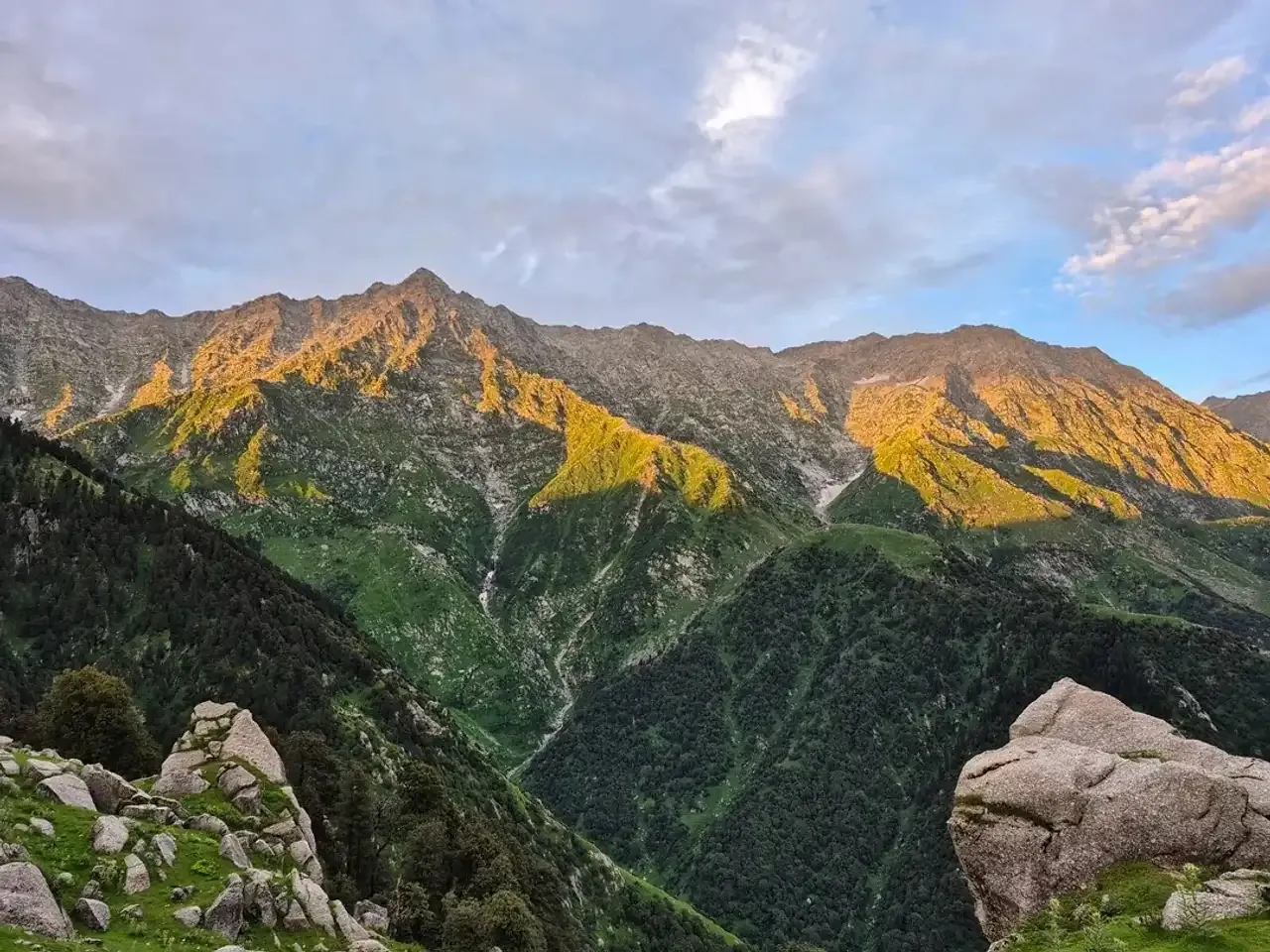
Triund is open most of the year but the ridge does not feel the same from one month to the next. Gear that was fine in May is useless in December. Routes that are obvious in October get lost under snow in February. This is the guide we wish someone had handed us the first time we made the climb.
The trail, in one paragraph
The climb starts at the Gallu Devi temple above Dharamkot, which is a twenty-minute drive or a steep hour's walk from McLeod Ganj. From there it is about nine kilometres and a thousand metres of ascent to the ridge at 2,875 m. The first two-thirds are a steady forest path through oak and rhododendron with tea stalls at intervals; the last kilometre, which everyone remembers, is a set of open switchbacks locally known as the twenty-two curves. Four to five hours up, two and a half to three down. You can do it as a long day, but the reason to camp is that the ridge at dawn and the ridge at two in the afternoon are not the same place. Guided overnights start at ₹1,500 — details on the Triund trek page.
March: the edge of the season
The forest stretch from Gallu Devi to Magic View is clean by early March, but the last kilometre before the ridge still holds patches of ice in the shaded switchbacks. The cafes open on rotation through the month. If you go in the first week, assume Bhangotu may be shut and carry extra water. By the last week of March, wildflowers start under the oak belt and the climb feels like a proper spring trek.
March is also the month the trail is at its most variable from one week to the next. A warm fortnight can clear the ice entirely; a late storm can put it all back. If you are booking March dates more than a week out, build in the possibility that you will want microspikes for the top section, and ask what conditions actually are rather than what the month usually does.
April and May: the sweet spot
This is the two-month window most regulars swear by. Days are warm, nights on the ridge hold between 8 and 12 degrees, and the cafes are fully stocked. The Kangra Valley below is not yet pre-monsoon hazy, so the view from the ridge stretches all the way to the Pir Panjal on a clear afternoon. Weekends get busy. If you can, book a Tuesday-Wednesday overnight. You will have the sunrise almost to yourself.
The one thing April and May do not give you is solitude. If your priority is having the sunrise to yourself, either take the midweek slot or plan to walk on past the ridge in the morning — twenty minutes further toward Laka Got and the crowd thins to nothing. May also brings the first properly hot afternoons on the lower forest section, which is an argument for starting at eight rather than eleven.
Monsoon, late June to mid-September
People go in the monsoon and love it. Others go once and never again. The forest smells magnificent. The oak bark turns almost black with moisture and the rhododendron is long past its bloom but the undergrowth is alive. The honest problem is visibility. The ridge can stay inside a cloud for forty-eight hours straight. Leeches appear on the lower trail in July. If this does not bother you, monsoon Triund is a quiet, meditative trek. If you came for the view, postpone.
Practical monsoon notes, if you go anyway: the rock steps on the last section are slick rather than treacherous, but they punish smooth soles. Leeches are a lower-forest problem and a non-event above the treeline — full-length socks and a small bottle of salt solve it. Camp gear gets wet and stays wet, which is the real reason to do a monsoon Triund as a day hike rather than an overnight. And the descent is the dangerous half, not the climb. The packing list has the wet-weather version.
October: the second sweet spot
The post-monsoon air is the reason photographers show up in October. Everything has been washed clean. The Dhauladhar peaks look as if they are closer than they actually are. You need a warmer layer at night than in May, but the payoff is sunrise after sunrise of the kind you usually see on postcards.
November: the quiet window
Fewer people, shorter days, a slightly thinner food menu at the cafes. The ridge light is soft all day in November because the sun stays lower. Good month for people who want Triund without the weekend crowd.
December to February: winter Triund
A different trek. The cafes close around mid-December. The ridge gets anywhere from ten centimetres to two feet of snow depending on the year. You need proper four-season gear, ideally a guide who knows the winter line, and the right expectations. You will be cold at night. You will probably not sleep well. But you will see the ridge the way most visitors never see it.
Splitting the winter further: December is usually the most reliable of the three, with settled cold, short days and the first real snow arriving toward the end. January and February are the serious months — the trail above Magic View can be a continuous snow slope rather than a path, and the route finding that is trivial in October genuinely is not. This is the one time of year when going with somebody who has walked the winter line recently stops being advice and starts being the difference between a good day and a rescue.
If it is snow you actually want, the snowline trek pushes above Triund to about 3,100 m and is built for exactly that.
One honest warning about weekend bookings
The forest department issues a capped number of ridge-camping permits on peak weekends. Some operators ignore this. If a price seems very low, ask where you will actually camp. The authorised sites are set back from the ridge edge and have a forest-appointed spot for fires. Anyone pitching tents on the crest itself is operating without paperwork, and it makes the trail worse for everyone who comes after.
What to carry, by season
- March, November — a warm mid-layer and a windproof shell; nights on the ridge are near freezing even when the day was pleasant.
- April to June — the lightest kit of the year, but still a proper insulating layer for the evening, and more water than you think for the forest section.
- Monsoon — a real rain shell rather than a poncho, boots with grip, dry bags for everything electronic, and a change of socks you keep sealed.
- October — the same as spring plus a warmer bag; clear nights are the cold ones.
- December to February — four-season boots, a bag rated well below freezing, microspikes, and a guide.
Getting to the trailhead
Gallu Devi is the start line, and how you get there sets up your day. A cab from McLeod Ganj takes twenty minutes and costs very little split between two or three people; walking up from Dharamkot adds an hour and about three hundred metres of climb to a day that already has a thousand. Most people who walk it regret it by the twenty-two curves. If you are already staying up in Dharamkot you are most of the way there. Rates for cabs and self-drive are on the rentals page.
So which month should you actually book?
If you have one weekend and you want the postcard: the second half of October. Clear air, warm days, cold clear nights, cafés still open. If you want the same view with better wildflowers and slightly warmer nights: mid-May, midweek. If you want the ridge to yourself and do not mind being cold: November. And if you want a trek rather than a view, go in winter with somebody who knows it, and understand that you are doing a different thing.
Triund is also the natural first step into everything else the Dhauladhar has — the ranked guide to the region's treks covers where it sits on that ladder, and tell us your dates if you want us to check what the trail is actually doing that week.
← All blog postsQuestions, answered
What is the best month to do the Triund trek?+
April–June and October–November are the most reliable: clear Dhauladhar views, open cafés and comfortable camping temperatures. December–February brings snow on the top section; July–August is monsoon and slippery.
How long does the Triund trek take?+
About 4–5 hours up from Gallu Devi temple (9 km, 1,000 m of climb) and 2.5–3 hours down. Most people go up after breakfast, camp on the ridge and return next morning.
How much does a guided Triund trek cost?+
From ₹1,500 per person (groups of two or more) including guide, camping on the ridge, meals on trek and permits.